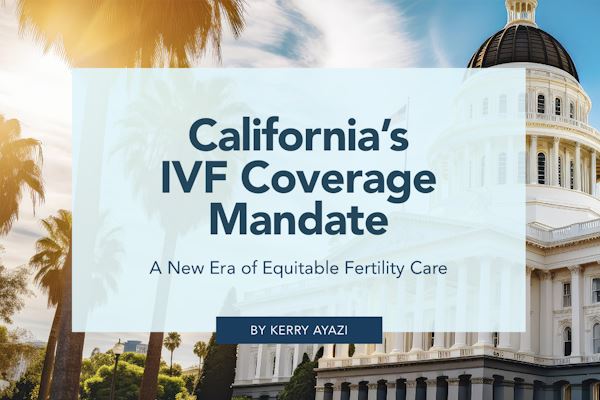
California’s IVF Coverage Mandate: A New Era of Equitable Fertility Care
By Kerry Ayazi, President & Chief Legal Officer at HRC Fertility and Pacific Council Member
Introduction
California is on the cusp of a historic shift in reproductive health policy. Building on previous targeted reforms such as Senate Bill 600 (SB 600), which clarified coverage of fertility‑preserving services under certain health plans, Senate Bill 729 (SB 729) will require fully insured, large‑group health plans to cover infertility diagnosis and in vitro fertilization (IVF), effective January 2026 after a budget‑related delay. According to Governor Newsom’s SB 729 signing message, the law expands access to fertility care and addresses long‑standing inequities in family‑building services.
In a San Francisco Chronicle story published on June 17, 2025, Sara Kwon reports on the historic move and shares insights from the public, “You think you finally have a helping hand,” said Ana Rios, a California resident, after learning the law would be delayed, describing the emotional toll of waiting.
Policy Background: Senate Bill 600
Signed into law in 2019, SB 600 clarified California’s approach to fertility coverage by specifying that when medically necessary treatments, such as chemotherapy, radiation, or surgery, may cause iatrogenic infertility, standard fertility preservation services are considered a basic health care benefit under state-regulated plans. These services, consistent with professional medical guidelines, include procedures such as egg, sperm, or embryo freezing. The law does not apply to Medi‑Cal managed care contracts and is declaratory of existing law, ensuring patients facing medically induced infertility have coverage for fertility preservation.
Policy Background: Senate Bill 729
Signed by Governor Gavin Newsom in September 2024, SB 729 requires fully insured health policies issued, amended, or renewed after July 2025 to cover infertility services, including IVF. It broadens definitions of infertility to ensure LGBTQ+ individuals, single parents, and same-sex couples are included. By doing so, California positions itself as a leader in reproductive equity. Coverage applies to large group plans, with a maximum of three egg retrievals and unlimited embryo transfers. Some smaller employer and public-employee plans may have different timelines or optional coverage, so not all Californians will automatically receive IVF benefits under SB 729.
By mandating coverage, the law reduces financial barriers that historically forced patients to pay tens of thousands out-of-pocket. According to Forbes Health, a single IVF cycle in the U.S. typically costs tens of thousands of dollars, sometimes not including certain medications, illustrating why insurance coverage is critical for many patients. Led by State Senator Caroline Menjivar, California’s initiative sets a precedent other states may follow, demonstrating how legislation can expand reproductive access while also promoting inclusion.
Case Study: HRC Fertility’s Preparation
HRC Fertility, one of California’s largest fertility networks, is proactively preparing for SB 729. The organization has expanded access points across the state, bolstered its physician teams, and curated financial counseling programs to help patients navigate insurance coverage questions. Outreach focuses on communities underserved in fertility care, including Californians long needing the support to start their families, LGBTQ+ families, and individuals who previously lacked any coverage options.
Innovations in Fertility Care
To complement SB 729, HRC Fertility is expanding programs designed to make IVF more accessible and less stressful:
- Needle-Free IVF: Replacing daily injections with alternative delivery methods to reduce stress and treatment drop-out.
- Gift Voucher Program: Allows friends and family to contribute directly to treatment costs, helping patients offset remaining financial barriers.
These efforts illustrate ways providers can support patients as new coverage requirements take effect.
Public Health Lens: Why Equity Matters
The World Health Organization (WHO) states that infertility affects roughly 1 in 6 people of reproductive age worldwide, yet access to treatment is often inequitable and costly. Equitable access is critical for mental health, family stability, and demographic diversity. The World Health Organization (WHO) recommends integrating fertility services into health systems and reducing financial barriers to ensure reproductive care is treated as a public health priority.
California Senate Bill 729 embeds these principles into California’s insurance framework. When combined with provider innovations like HRC Fertility’s needle-free IVF and gift programs, the state moves toward a model in which IVF and fertility care are accessible to more families than ever before.
Conclusion
While we have a way to go for even greater access, SB 729 is a start; and it is more than a legislative milestone; it is a declaration that IVF care is a matter of equity and public health. By requiring insurance coverage for IVF and expanding definitions of infertility, SB 729 dismantles several barriers that long excluded many families.
HRC Fertility’s proactive response, from affordability initiatives to pioneering programs, illustrates how policy and innovation can work together to transform the fertility landscape. According to Governor Newsom’s SB 729 signing message, as the law takes effect in 2026, California may serve as a national model for more equitable, accessible fertility care.
Author Bio
Kerry Ayazi is Administrative President & Chief Legal Officer of HRC Fertility and a member of the Pacific Council on International Policy. She has been recognized among the Los Angeles Business Journal’s Women of Influence in Health Care (2024), won numerous awards, and was also featured in Authority Magazine for her insights on women’s leadership. Under her leadership, HRC Fertility has advanced reproductive health and IVF health equity and innovation, including initiatives like needle-free IVF, fertility gift vouchers, and patient education programs. Kerry also contributes globally through mentorship and volunteer work supporting education and access for children, especially girls, in challenging environments.